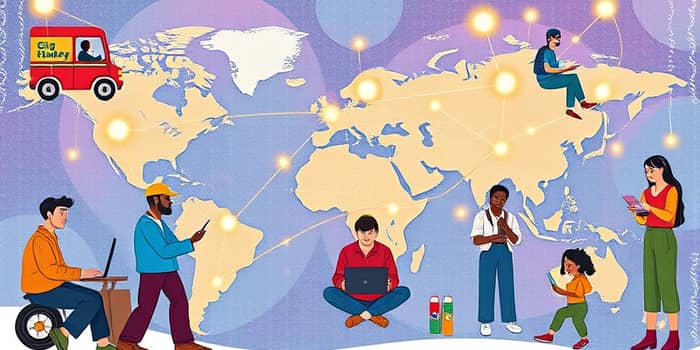
From bustling urban centers to remote corners of the globe, the gig economy is redefining how work is created, distributed, and valued. In 2025, this dynamic sector is not only a catalyst for innovation but also a mirror reflecting economic shifts, social changes, and regulatory challenges. This article delves into the latest data, emerging trends, and practical strategies to help stakeholders navigate a landscape marked by both opportunity and uncertainty.
The term gig economy encompasses a wide spectrum of work arrangements, from ride-sharing drivers and delivery couriers to freelance consultants and creative professionals. It includes platform-driven gig sector growth as well as offline task-based jobs and self-employed entrepreneurs operating outside digital marketplaces.
Key components of this ecosystem are:
By 2025, estimates place the global platform-driven segment between 455 and 646 billion dollars, while total gig and freelance activity could generate as much as 3.8 trillion dollars annually. With an unprecedented annual growth rate ranging from 16 to 17.4 percent, this sector outpaces many traditional industries.
In the United States alone, the gig economy contributes roughly 5 percent of GDP, equivalent to 1.3 to 1.5 trillion dollars, on par with construction or transportation. Over 70 million Americans, representing 36 percent of the workforce, engage in gig work in 2025.
Multiple factors are fueling expansion:
Urban centers account for the lion’s share of gig activity, with 43 percent of freelancers clustered in metropolitan areas. Emerging economies are experiencing the fastest growth, driven by mobile internet penetration, rising digital literacy, and a shortage of formal employment opportunities.
Regions like India, Indonesia, Brazil, and Australia are seeing double-digit annual growth rates, with India poised to reach 23.5 million gig workers by 2030. The demographic profile spans ages, educational backgrounds, and skill levels, making the gig economy a truly global phenomenon.
The sector can be broadly divided into two categories: low- to medium-skilled on-demand services and high-skilled professional freelance work. On-demand services—such as ride-share driving, food delivery, and household tasks—remain a cornerstone in many markets.
Concurrently, professional gig work in AI modeling, data analytics, healthcare consulting, and fractional finance is surging. Six-figure incomes are now within reach for 4.7 to 5.6 million US freelancers, up from three million in 2020, as organizations seek specialized expertise without committing to full-time hires.
While the gig economy offers unparalleled flexibility and autonomy, it also exposes workers to income volatility and limited benefits. Many gigs provide multiple income streams, sparking entrepreneurial spirit and opening access to global markets.
On the downside, 62 percent of gig workers report difficulty managing unpredictable income, and lack of healthcare or retirement plans adds long-term risk. The recurring feast-or-famine pattern can lead to stress and burnout, challenging traditional notions of job security.
Governments around the world are grappling with how to integrate gig work into existing labor frameworks. The introduction of hybrid worker categories in some regions aims to balance worker protection with business agility. Debates center on portable benefits, minimum earnings thresholds, and tax compliance.
The European Union advances portable benefit schemes, while the United States explores third-category designations. Emerging economies like India are crafting guidelines to protect frontline platform workers without stifling growth, creating a mosaic of regulatory approaches.
Looking toward 2030, the freelance platform market alone could exceed 16 billion dollars, and gig work may constitute the primary employment model in advanced economies. We anticipate seamless AI-human collaboration models and robust public-private safety nets.
Investment in upskilling and digital infrastructure will be critical. As platforms innovate, transparent metrics and consistent definitions will help stakeholders measure impact and value, reducing the discrepancies that currently cloud global comparisons.
Despite its momentum, the gig economy faces hurdles. Securing steady work remains a top concern, with 66 percent of freelancers citing inconsistent job volume. Career progression pathways are often ill-defined, and workers may struggle to achieve long-term financial stability.
Additionally, cross-border regulation of digital nomads and remote contractors poses legal and tax complexities. Platforms, governments, and workers must collaborate to establish clear guidelines and support mechanisms to foster a sustainable ecosystem.
The gig economy’s rapid rise has ushered in a new era of opportunity, innovation, and adaptability. It challenges traditional employment paradigms and demands fresh approaches to worker rights, corporate strategy, and public policy.
By harnessing data-driven insights, fostering inclusive regulations, and investing in human capital, stakeholders can shape a future where gig work thrives sustainably. In this evolving landscape, collaboration and foresight remain the keys to unlocking the full potential of a global workforce unbound by the constraints of yesterday.
References