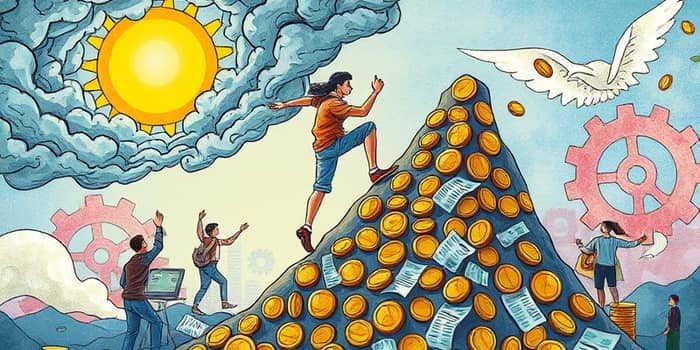
Financial markets are rarely flawless. Hidden frictions, information gaps, and enforcement costs mean that access to credit and investment opportunities is uneven. Yet, within these cracks of imperfection lie seeds of resilience and innovation.
By accepting imperfections as part of the process, individuals, firms, and economies can learn to adapt, innovate, and ultimately thrive. This article explores how acknowledging financial imperfections becomes a catalyst for growth.
In theoretical economics, deviations from the ideal perfect market are called financial or capital market imperfections. These arise when participants lack full knowledge or enforcement mechanisms are weak.
Key sources include:
In everyday life, these imperfections become tangible obstacles:
Creditworthy individuals may face collateral requirements that exclude many from loans. Small businesses often encounter credit rationing in harsh downturns, stifling their capacity to invest and grow. Mispriced capital can also trigger both underinvestment and overinvestment in certain sectors, creating cycles of boom and bust.
For households, missing out on affordable credit can derail educational plans, homeownership, or entrepreneurial dreams. During downturns, those with weaker balance sheets face amplified hardship, illustrating the amplification of economic shocks.
Firms with limited internal funds adopt risk-averse strategies, often avoiding high-return projects because external financing is costly or scarce. At times, they overaccumulate cash or take excessive risks to hedge against future constraints, creating inefficiencies.
Beyond technical frictions, human biases shape market inefficiencies. Herd behavior and momentum trading can inflate asset prices, and frequent portfolio churn imposes a “tax” on long-term savers.
Recognizing these biases allows for adaptive financial strategies over time. Investors who resist following the crowd and focus on fundamentals often uncover value overlooked by emotional traders.
When imperfection drives innovation, innovative financing solutions emerge to bridge gaps. Peer-to-peer lending, microfinance, and alternative credit scoring have all grown in response to unmet demand for capital.
Individuals and firms can reset expectations by:
Effective policy reduces friction through enhanced transparency, stronger enforcement, and broader credit access. Initiatives include credit bureaus that aggregate alternative data, and macroprudential measures like countercyclical capital buffers.
Targeted support for the underserved—such as microfinance programs—helps small entrepreneurs build credibility. Regulators can moderate credit cycles, dampening both excessive exuberance and deep contractions.
Stories of perseverance illustrate how embracing imperfection becomes a pathway to growth. Consider a startup founder rejected by traditional banks, who turned to a global crowdfunding community, achieving both funding and a loyal customer base before launch.
Or a young family barred from a mortgage due to thin credit history, who used consistent rent and utility payment records to build their profile. Through patience and strategic planning, they secured a home loan at competitive rates.
These narratives remind us that constraints can spark creativity and resilience. Each setback becomes an opportunity to reassess, adapt, and move forward more strongly.
Financial imperfection is not merely an obstacle—it is a crucible for growth. By recognizing market frictions, adopting resilient and adaptive strategies, and leveraging innovative solutions, individuals and firms can navigate uncertainty with courage.
Policy makers, too, play a critical role in smoothing the path, creating frameworks that balance stability with flexibility. As we embrace imperfection, we unlock the potential for collective progress and sustainable prosperity.