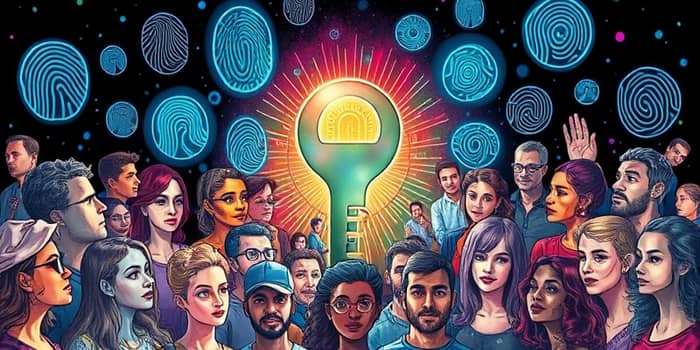
In a world awash with passwords, PINs, and tokens, your body or behavior as the unique key has become the frontier of authentication. Biometric security leverages the individual patterns etched in our physiology and movements to verify identity with unprecedented precision.
From fingerprints to facial features, iris patterns to gait analysis, this technology transforms personal traits into digital credentials. As organizations and individuals seek both convenience and stronger defenses, biometrics step forward as the bridge between robust security and seamless user experience.
At its core, biometric security rests on matching a live sample against a stored digital template of a physical or behavioral trait. Advanced sensors capture unique markers—like minutiae points in fingerprints or three-dimensional facial contours—and algorithms convert them into mathematical representations.
Machine learning then analyzes these templates to accommodate variations from lighting, aging, or minor injuries. Continuous improvements in AI ensure that systems remain adaptive, reducing errors without sacrificing speed.
Biometrics have moved from novelty to norm, embedding themselves into airports, banking platforms, smartphones, IoT ecosystems, and payment cards. In 2025, Japan rolled out the world’s first consumer biometric payment cards, enabling contactless authentication with a fingerprint imprint on the card surface.
Meanwhile, the European Union’s Entry-Exit System (EES) phases in biometric checks at borders, signaling large-scale government reliance on these techniques. As digital identity frameworks evolve, biometrics play a central role in meeting Know Your Customer (KYC) and anti-money laundering requirements.
Recent breakthroughs have focused on enhancing both accuracy and usability. Modern systems employ real-time liveness detection and anti-spoofing to differentiate a living subject from photos, masks, or deepfake videos. By integrating 3D sensors with AI, depth maps capture facial contours that frustrate fraudulent attempts.
Contactless modalities—facial, iris, palm vein scans—deliver contactless and frictionless user experience, essential in healthcare and public transit. On-device processing, paired with privacy-preserving, decentralized processing on-device, means templates stay local, alleviating many privacy concerns.
Understanding error rates is vital for assessing biometric performance. No system is infallible, but continuous refinements have driven false matches and rejections to historically low levels.
Biometrics deliver hard to steal or replicate credentials that scale across devices and environments. By tying access to inherent traits, organizations replace or augment passwords, reducing phishing and credential stuffing attacks.
Users enjoy enhanced security and user convenience—no more forgotten passwords or complex rotations. Continuous or passive authentication can maintain secure sessions silently in the background, balancing protection and productivity.
Despite dramatic improvements, biometric solutions confront several obstacles. Privacy remains top of mind: a compromised biometric template cannot be reset like a password. Central repositories of biometric data are high-value targets for threat actors.
Jurisdictions worldwide—led by GDPR in Europe and CCPA in California—mandate informed consent and transparent policies for collecting and storing biometric identifiers. Organizations must embed privacy by design, ensuring templates are encrypted and access is strictly controlled.
Ethical oversight is crucial to prevent surveillance creep, where systems built for security morph into tools for mass monitoring. Fighting bias requires diverse training data and regular audits to guarantee fairness for all users.
The horizon for biometric security is animated by the convergence of AI, IoT, and edge computing. We anticipate seamless, adaptive systems that recognize individuals across devices, contexts, and networks. Emerging frameworks—such as fully homomorphic encryption and blockchain-based identity wallets—promise stronger privacy guarantees without sacrificing performance.
As regulations crystallize and standards coalesce, biometric authentication will cement its role as the cornerstone of digital trust. By balancing innovation, ethics, and security, we can ensure that our identities remain truly in our control.
In embracing biometrics, organizations and individuals alike hold the power to transform identity into both the key and the fortress for our digital future.
References