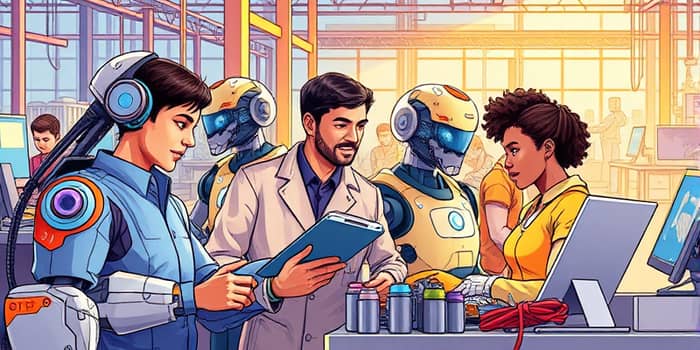
Automation and artificial intelligence are reshaping the world of work at unprecedented global labor churn. As machines assume routine tasks and AI augments complex processes, millions of workers face both disruption and opportunity. This article dives into the data, human stories, and policy approaches needed to navigate this era of rapid technological shifts and to seize the promise of a more productive, creative workforce.
Recent analyses indicate that up to 300 million jobs lost may occur globally as AI and automation mature. By 2030, as many as 400 to 800 million individuals could be displaced and forced to seek new employment. In the United States alone, automation has already eradicated 1.7 million manufacturing positions since 2000, while 20 million more workers may need retraining in the next three years.
Yet the story is not only one of loss. Productivity gains from generative AI could boost output by up to 15% in developed economies, fueling new industries and jobs. Historical precedents show that technological revolutions eventually generate net employment growth, but the pace of change demands proactive strategies to ensure no one is left behind.
The impact of automation is far from uniform. Routine, repetitive roles remain at highest risk, while jobs demanding creativity and emotional intelligence enjoy greater resilience. Key trends include:
These shifts deepen wage polarization: those equipped with adaptable, high-level digital skills capture the benefits, while lower-skilled workers face wage stagnation and job insecurity.
Examining specific regions reveals how local dynamics shape outcomes. In East Asia, early robot adoption displaced low-skilled workers but drove growth in skilled manufacturing roles. Total employment in high-adoption economies continues to rise, demonstrating the dual nature of automation.
In the United Kingdom, projections show 1 to 3 million jobs could be directly displaced by AI. Unemployment may spike temporarily, but historical recoveries suggest a rebound as workers retool for new positions. Meanwhile, in ASEAN countries, robotics cost 1.4 million low-skilled jobs but created 2 million higher-skilled roles, underscoring the importance of flexible education systems.
The gig economy also adapts: platforms leverage automation to match supply and demand more efficiently, but the result can be increased precarity and compressed wages for freelance and contract workers.
Reskilling and upskilling stand out as the most powerful levers to counter disruption. Over 20 million U.S. employees may require new training in the coming years. Yet globally, infrastructure for adult education remains uneven, and many workers lack access to affordable, high-quality programs.
By focusing on dynamic reemployment pathways, governments and firms can minimize unemployment spells and preserve wages as workers transition.
At the macro level, the productivity boost from AI could expand global GDP by trillions of dollars, but benefits risk being unevenly distributed. Automation may displace up to $14.6 trillion in wages—surpassing the GDP of every country except the U.S. and China. Without inclusive policies, inequality could worsen, eroding social cohesion.
However, automation also offers supply-side gains in education and healthcare. AI-powered tutoring could raise learning outcomes, while diagnostic tools may extend healthcare access in underserved regions. These spillover effects could increase labor force participation and foster healthier, more educated populations.
Addressing this transformation requires coordinated efforts across public, private, and civil society actors. Key recommendations include:
Proactive labor market reforms and upgraded education systems can transform displacement into opportunity, ensuring a fair transition for all.
The pace of automation will shape two broad narratives. In a rapid-automation scenario, mass displacement could strain social systems and deepen inequality. Conversely, a deliberate, balanced approach can drive a meaningful workforce transformation, where AI and humans collaborate to produce higher-value outputs.
History teaches that technology seldom delivers its full promise without thoughtful governance and human-centered design. By prioritizing agility, equity, and innovation, societies can navigate these changes and create a future in which work is more fulfilling, creative, and resilient.
Automation’s impact on global labor markets is profound and multifaceted. The challenge before us is to harness AI’s power for good, turning disruption into a catalyst for growth, inclusion, and human potential. Governments, businesses, and individuals must unite around collaborative adaptation strategies—investing in people, rewriting education paradigms, and forging policies that embed fairness at the heart of progress.
As we stand at this crossroads, the choices we make today will define the work of tomorrow. By embracing change with empathy and foresight, we can build a labor market that reflects our highest aspirations: one where technology uplifts every worker and unlocks a more equitable, prosperous future.
References