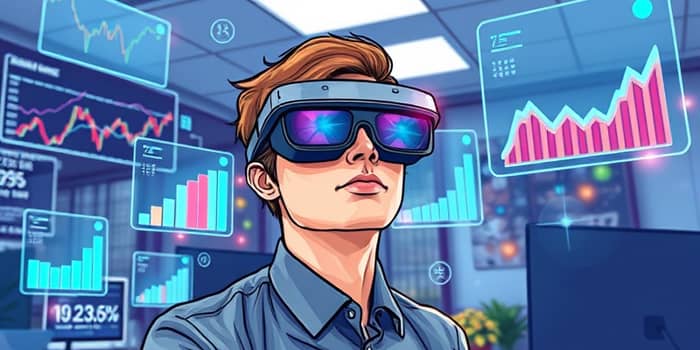
Financial data can feel overwhelming. Spreadsheets, static charts, and endless columns often leave users disconnected from the real impact of their decisions. But what if you could step into your data, explore its shape, and interact with it as though it were a living model?
Enter augmented reality (AR), a technology that overlays computer-generated visuals onto the real world in real time. By transforming dry numbers into immersive experiences, AR promises dynamic, interactive 3D financial models and a tangible connection to your money.
Augmented reality superimposes digital elements—such as charts, graphs, or simulations—onto a user’s physical environment. Unlike virtual reality (VR), which fully immerses you in a virtual world, AR enhances reality by blending the physical and digital.
This technology is part of the broader spectrum of extended reality (XR), encompassing VR and mixed reality (MR). In finance, AR has evolved from niche prototypes to real-world pilots, thanks to devices like Microsoft HoloLens and AR-enabled smartphones using ARKit and ARCore frameworks.
Its appeal lies in in-depth, immersive data exploration. Instead of interpreting rows of numbers on a screen, investors, bankers, and everyday users can manipulate models and witness outcomes in a spatial context.
Traditional graphics are static—once created, they can’t adapt to new variables. AR breaks this mold by offering live, three-dimensional visuals that respond to user input. Imagine adjusting interest rates with a gesture and seeing a mortgage schedule reshape around you in real time.
These tangible and immersive experiences help reduce complexity. You’re no longer parsing a table of figures; you can see how expenditures cluster on a tabletop or how asset classes rise like skyscrapers on a virtual skyline.
Leading financial institutions have begun embedding AR in a variety of applications. Use cases span from consumer banking to professional trading, each harnessing AR’s power to make data more accessible.
Deploying AR in financial contexts yields multiple advantages over traditional interfaces. From customer engagement to internal efficiency, the technology has measurable effects.
Despite its promise, AR adoption faces hurdles. Developing custom AR applications and procuring hardware such as headsets or AR glasses remain costly investments for many institutions.
Moreover, AR’s reliance on real-time data streams raises heightened data security concerns. Financial information is sensitive; any breach of an AR interface could expose detailed personal or institutional records.
User education is also critical. While AR can simplify complex topics, it demands a baseline of digital literacy. Less tech-savvy demographics might resist or misinterpret AR visualizations, potentially leading to misinformed decisions.
The horizon for AR in finance extends well beyond basic dashboards. As 5G networks and edge computing mature, AR experiences will become smoother and more accessible on smartphones and wearable devices.
We can anticipate collaborative AR war rooms where remote teams analyze live data in shared virtual environments. Blockchain integration may enable transparent, auditable AR-driven transactions. Insurers could employ AR for real-time claim assessments, overlaying damage estimates on policy documents.
Gamification will continue to drive user adoption, particularly among younger demographics. Interactive quizzes and scenario-based simulations will foster longer-lasting knowledge retention and more confident financial behaviors.
Augmented reality is poised to redefine how we interact with numbers, budgets, and investment portfolios. By turning financial data into living, navigable landscapes, AR bridges the gap between abstraction and real-world impact.
As hardware costs decline and digital literacy grows, we will see a proliferation of AR tools across retail banking, asset management, insurance, and beyond. This transformational shift promises not only better individual decision-making but also a more inclusive, transparent financial ecosystem.
References